
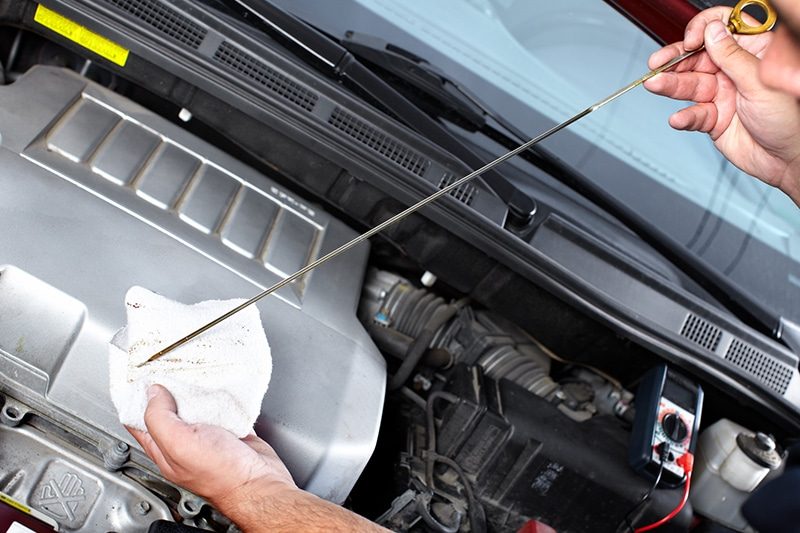
A real car diagnostic is a technician confirming which part has failed, and why, before anything gets replaced. The code your check engine light stores is the starting point. The diagnosis is the testing that happens after it: checking the circuit, measuring the sensor, watching the live data, and proving the failure. At our shop, the last step is showing you the evidence. We photograph what we find and share those photos with you, so you see the worn part or the leak with your own eyes before you approve a dollar of work.
That’s the short answer. The longer one is worth a few minutes, because the difference between a code read and a diagnosis is where most of the money in car repair gets won or lost.
A code is a question, not an answer
Every parts store in Littleton will plug a reader into your car for free. That’s a genuinely useful service, and I’d never tell you not to use it. But it’s worth knowing what that number actually tells you.
A code like P0171 means the engine is running lean. It does not tell you why. A vacuum leak can do it. So can a dirty mass airflow sensor, a weak fuel pump, a clogged injector, or a failing oxygen sensor. Those repairs range from a few dollars to well into the hundreds, and the code alone can’t tell them apart.
What usually happens next is the part the internet associates with that code gets bought and installed. Sometimes that works. Often it doesn’t, and now the car still has the original problem plus a receipt for a part it didn’t need. Every month somebody comes through our door after exactly that, and it’s the most avoidable expense in car ownership.
If you want to understand the codes themselves, we wrote a longer piece on OBD codes and what they mean. The point here is simpler. The code is the question. Diagnosis is the answer, and they aren’t the same thing.
What actually happens during a diagnosis
A proper diagnosis follows the same basic path whether it’s a warning light, a noise, a leak, or a car that just doesn’t feel right.
First, we talk to you. When did it start, does it happen cold or warm, at highway speed or in the parking lot, after fueling, on hills? Those details narrow things down faster than any scan tool. A misfire that only shows up climbing toward Evergreen points somewhere different than one that happens at a stoplight.
Then we pull the stored codes, and just as importantly the freeze frame data that goes with them. Freeze frame is a snapshot of what the engine was doing at the moment the fault set: speed, temperature, load, fuel trim. It’s the closest thing to being in the car when it happened.
After that comes the actual testing, and this is where a technician earns the title. Depending on the problem it might mean watching sensor readings live while the engine runs, smoke testing the intake to find a vacuum leak, measuring voltage and resistance at a connector, pressure testing the cooling system, or checking fuel pressure against spec. The goal is to verify the failure. Verifying failures is how you avoid replacing parts that were never broken.
Our technicians are ASE Master Certified, and a lot of what that certification represents is exactly this kind of work: knowing which test answers which question, and in what order.
Why we photograph what we find
When the diagnosis is done, you get a call explaining what we found. You also get photos.
We do this because a phone call asking you to approve a repair on a part you can’t see puts you in an uncomfortable spot. You either trust the person on the other end or you don’t, and neither feels great when it’s your money. A photo of a cracked belt, a wet water pump, brake pads worn to the backing plate, or a corroded connector changes that conversation. You’re deciding with the same information we have.
It also helps when we find more than one thing, which happens. Cars tend to get looked at when something goes wrong, and while the car is on the lift we’ll often notice something else that’s wearing. With photos, you can look at each item, ask about it, and decide what needs doing now and what can wait. Plenty of things can wait, and we’ll tell you which ones. Something that’s seeping slightly is not the same as something that’s about to leave you on the side of C470, and you deserve to know the difference.
And if you’d like to show the photos to someone else before you decide, a spouse, a friend who knows cars, or another shop, go right ahead. That’s your right, and honestly it’s one of the reasons we send them.
What a diagnosis should cost, and how to think about it
I get asked this a lot, and the fair answer is that a diagnostic fee pays for a technician’s time with your car. A straightforward fault might take a short while to confirm. An intermittent electrical problem that only shows up on cold mornings can take a lot longer, because you have to wait for it to happen while you’re watching.
Here’s how I’d think about it as a customer. The diagnostic fee is the cheapest part of most repairs, and it’s the part that keeps the rest of the bill honest. Skipping it to save money tends to cost more, because the alternative is buying parts on a guess. A shop that offers to fix the problem without testing anything first is asking you to pay for its guesses.
A few questions are worth asking any shop before you hand over the keys. Will you call me before doing anything beyond the diagnosis? Will you tell me what you tested and what you found? Can I see the part, or a picture of it? A good shop says yes to all three without hesitating.
We also keep a coupon for diagnostic work on our auto repair coupons page, so check there before you come in.
When to get a diagnosis right away
Most warning lights and noises give you a little time. A few don’t.
A flashing check engine light usually means an active misfire, and driving on it can damage the catalytic converter. Pull over when it’s safe, and get it looked at before you drive much further. Our check engine light page goes into the steady versus flashing difference in more detail.
A temperature gauge climbing toward hot, a red oil pressure light, a brake pedal that suddenly feels soft, or a battery light that comes on while you’re driving all fall into the same category. Those are the ones where a few more miles can turn a modest repair into a big one.
Everything else, a light that’s steady, a new noise, a small drip on the driveway, deserves attention soon but rarely needs a tow. Call us, describe what’s happening, and we’ll tell you honestly whether it’s a drive-it-in situation or a park-it-now one.
A second opinion is a diagnosis too
If another shop has already given you a quote and something about it doesn’t sit right, a second diagnosis is often the smartest money you’ll spend. We do this regularly, and sometimes the answer is that the first shop was right and the price was fair. Sometimes it isn’t. Either way, you walk away knowing. We wrote more about that on our second opinion page.
What happens after you approve the work
Once you’ve seen the photos and decided what you want done, we do the repair, and it’s backed by our 48 month, 50,000 mile warranty on parts and labor. For the first 24 months or 24,000 miles it’s honored at NAPA AutoCare shops nationwide, which matters if the car spends any time on road trips. The warranty page has the full terms.
That’s really the whole approach. Find the actual problem, show you the evidence, let you decide, and stand behind the work. It’s how we’ve run the shop at C470 and Bowles since 2008, and it’s why a lot of our customers have been bringing us their cars for most of that time.
If something on your car has you guessing, request an appointment or give us a call. We’ll find out what’s really going on, and you’ll see exactly what we see.