Auto Repair In Littleton
That You Can Trust Book Appointment Get Your 2nd Opinion
That You Can Trust Book Appointment Get Your 2nd Opinion

Cars, Trucks, SUV & Hybrid Auto Repair
Call Dakota Ridge Auto Today!
Call Dakota Ridge Auto Today!
Overheating is the failure that turns a $300 repair into an engine. We pressure test the system and find the actual leak rather than replacing parts until it stops.
Almost every catastrophic engine failure we see started as a cooling problem somebody drove a little further on. The good news is that cooling systems announce themselves early and clearly, if you know what the signs are.
 Reviews published on Google
I brought my car in for major repairs. Michael explained the work that was needed. Then kept me updated as the repairs proceeded. It is so refreshing to deal with an honest company that does excellent work. I would highly recommend them to anyone. And I won't take my car anywhere else.
They were incredibly kind, honest, and easy to work with from start to finish. My car needed a lot of work, and they handled everything quickly while keeping me in the loop the whole time. I never felt rushed or talked down to, which goes a… read the rest on Google
Very friendly and helpful staff. They helped me when my engine guard came off and also noticed an oil leak I wasn’t aware of.
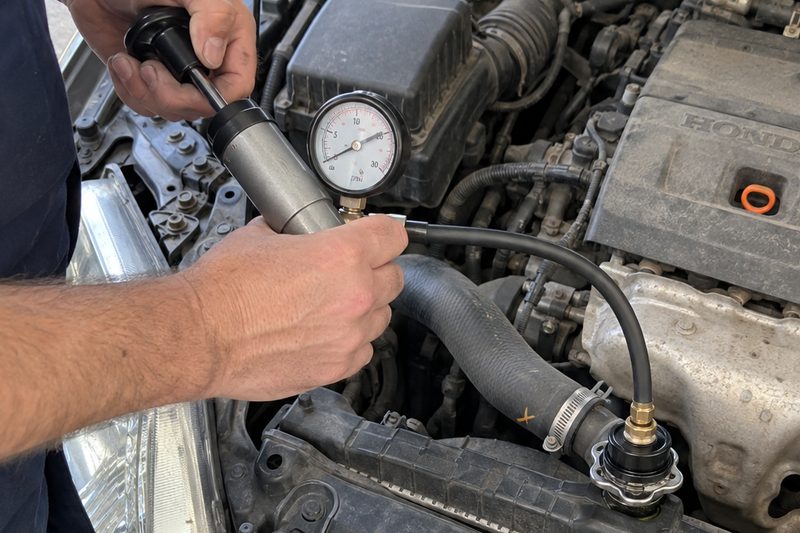
We start with a pressure test. The system gets held at its normal operating pressure while cold, which makes a leak reveal itself without waiting for the car to be hot and dangerous to work on. We test the cap, check the coolant condition and mixture, verify the thermostat is actually opening, confirm the fan engages, and check for combustion gases in the coolant if a head gasket is on the table.
Coolant is not universal. Modern cars use several incompatible chemistries, and mixing them produces a gel that plugs heater cores and radiators. We use the type your manufacturer specifies. If a previous shop mixed it, we will tell you what we found.
Altitude matters more here than most places. Water boils lower at 5,400 feet than at sea level, which shrinks the safety margin on a weak cap or a slightly low mixture. Systems that would limp along elsewhere overheat here.
Replacement and flow testing. Rock damage from the highway is the most common cause we see.
Often bundled with a timing belt on interference engines, because doing it twice costs far more than doing it once.
The cheapest part in the system and the cause of a surprising share of both overheating and no-heat.
Upper, lower, heater and bypass. Soft, swollen or crazed hoses fail without warning and always on a Sunday.
Electric fans, relays, sensors and mechanical clutches on trucks.
Block testing for combustion gases in the coolant, so a head gasket is confirmed before it is quoted.
Say the code when you call, or show this page on your phone at the counter. Nothing to print.
Up to $50 off, scaled to the size of the job
Say SERVICE when you call to book your appointment
Excludes towing, tires and batteries. Tax and shop supplies excluded. One coupon per invoice. Not good in combination with any other offer.
That pattern usually means airflow rather than coolant flow. At speed air is forced through the radiator regardless of the fan; in traffic the fan is doing all the work. A fan, relay, sensor or fan clutch that is not engaging produces exactly this symptom.
To get off the road safely, yes, water is better than driving it hot. As a repair, no. Straight water freezes, boils lower than coolant, and does not carry the corrosion inhibitors that keep the inside of your engine from rusting. Get the mixture corrected soon after.
The reliable test is a block test that checks for combustion gases in the coolant, plus a pressure test and a look at the oil. Milky oil, white exhaust smoke that smells sweet, an overflow tank that bubbles, and unexplained coolant loss with no visible leak all point that way. We confirm it before quoting it, because it is a big enough repair that guessing is unacceptable.
Follow the manufacturer interval, commonly somewhere between 5 and 10 years or 100,000 miles for long-life coolants. Condition matters more than age: coolant that has gone acidic or rusty is actively eating the system and should come out regardless of the calendar.
A drip you can see is not an emergency, but it is a countdown. A temperature gauge climbing is an emergency. The gap between those two is usually where a cheap repair still exists.
Do not drive it any further than you have to. Call us and we will tell you whether it is safe to bring in or needs a tow.
Open Monday through Friday, 8:00am to 5:30pm. Courtesy shuttle within about five miles.