Auto Repair In Littleton
That You Can Trust Book Appointment Get Your 2nd Opinion
That You Can Trust Book Appointment Get Your 2nd Opinion
Cars, Trucks, SUV & Hybrid Auto Repair
Call Dakota Ridge Auto Today!
Call Dakota Ridge Auto Today!
Worn suspension does not usually announce itself. It just quietly lengthens your stopping distance and eats a set of tires while the car still feels “fine.”
Front Range roads are hard on suspension: freeze-thaw potholes, gravel, construction on C470 and enough dirt roads within thirty minutes to matter. Components here wear on a shorter clock than the maintenance schedule assumes.
 Reviews published on Google
Dakota Ridge Auto provided great service. The staff were extremely friendly and helpful, the shop was quick and organized, and the mechanics were very knowledgeable. Top 3 things I loved: 1) Friendly service 2) Quick, organized repair… read the rest on Google
Dakota Ridge Auto was incredibly efficient and friendly. I brought my car in for an oil change and the staff explained everything clearly while getting the job done quickly. I left feeling confident about the service and will definitely return for any future car maintenance.
I went to Dakota Ridge Auto for a tire swap. I didnt want new tires, just the snow tires swapped out. The friendly staff called me and told me one of my tires was bad and needed to… read the rest on Google
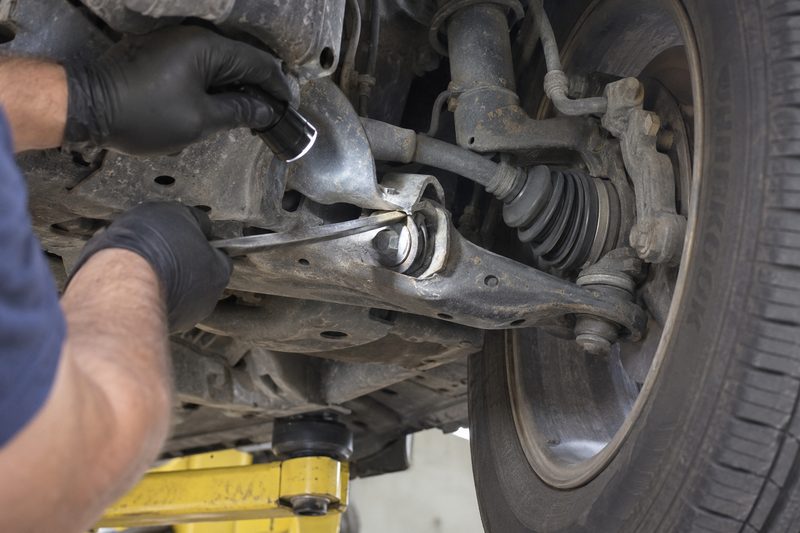
A proper suspension inspection happens on a lift with the weight off the wheels, because that is the only way play in a joint reveals itself. We check ball joints, tie rods, control arm bushings, sway bar links and bushings, strut mounts and bearings, springs, and the dampers themselves.
We replace in pairs across an axle. A new strut on one side and a worn one on the other gives you a car that behaves differently depending on which way it is turning, which is worse than two evenly worn ones.
Any suspension work that changes geometry gets an alignment afterward. Skipping it means the new parts wear the tires just as fast as the old ones did, which is a strange way to spend money.
Replaced in pairs, with the mounts and bearings that fail alongside them.
The safety-critical ones. Play here is measured, not estimated.
Control arm and sway bar bushings, which cause most of the clunks people live with for years.
Broken coils are more common here than people expect, especially on cars that see winter roads.
Racks, pumps, and the leaks that precede their failure.
Always, when geometry changed. Otherwise the new parts eat the tires too.
Say the code when you call, or show this page on your phone at the counter. Nothing to print.
Up to $50 off, scaled to the size of the job
Say SERVICE when you call to book your appointment
Excludes towing, tires and batteries. Tax and shop supplies excluded. One coupon per invoice. Not good in combination with any other offer.
Often quoted at 50,000 to 100,000 miles, but Colorado roads push that to the short end. Better to judge by behavior and inspection than by the odometer: bounce, cupped tire wear and nose dive are the signals.
We recommend it strongly. A fresh damper on one side of an axle and a worn one on the other makes the car handle asymmetrically, which is most noticeable exactly when you need it least.
If the work changed geometry, yes. Struts, control arms, tie rods and ball joints all move alignment. Skipping it wears out the tires you just paid to protect.
It depends entirely on what is clunking. A sway bar link is annoying. A ball joint with play in it is a safety item, because when those fail the wheel can separate from the steering. That is why the diagnosis matters more than the noise.
Get it up on a lift and inspected. Most suspension complaints turn out to be cheaper than people fear.
Open Monday through Friday, 8:00am to 5:30pm. Courtesy shuttle within about five miles.